17. The Canter
The whole of the exercises on circles should next be performed in a canter; which may be commenced from a short but animated trot, a walk, or even a stop. If the horse be well trained, a slight pressure of the whip and leg, and an elevation of the horse's head, by means of the reins, will make him strike into a canter. Should he misunderstand, or disobey these indications of the rider's will, by merely increasing his walk or trot, or going into the trot from a walk, as the case may be, he is to be pressed forward on the bit by an increased animation of the leg and whip;--the reins, at the same time, being held more firmly, in order to restrain him from advancing too rapidly to bring his haunches well under him; for the support of which, in this position, he will keep both his hind feet for a moment on the ground, while he commences the canter by raising his fore feet together.
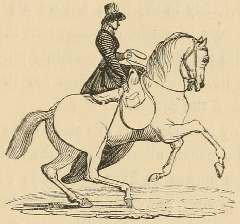
The canter is by far the most elegant and agreeable of all the paces, when properly performed by the horse and rider: its perfection consists in its union and animation, rather than its speed. It is usual with learners who practise without a master, to begin the canter previously to the trot; but we are supported by good authority in recommending, that the lady should first practise the trot, as it is certainly much better calculated to strengthen and confirm her in the balance, seat &c. than the canter.
The lady is advised, at this stage of her progress, to practise the paces, alternately, in the various combinations of the figures we have described; performing her aids with greater power and accuracy in turning and working in circles, when trotting or cantering, than when walking. She should also perfect herself in her aids, the correspondence, and balance, by alternately increasing and diminishing the speed in each pace, until she attain a perfect mastery over herself and her horse, and can not only make him work in what direction, and at what pace, but, also, at what degree of speed in each pace, she pleases.
The horse ought to lead with the right foot: should he strike off with the left, the rider must either check him to a walk, and then make him commence the canter again, or induce him to advance the proper leg by acting on the near rein, pressing his side with the left leg, and touching his right shoulder with the whip. His hind legs should follow the direction of the fore legs, otherwise the pace will be untrue, disunited, and unpleasant, both to horse and rider: therefore, if the horse lead with his near fore leg (unless when cantering to the left--the only case when the near legs should be advanced), or with his near hind leg, except in the case just mentioned--although he may lead with the proper fore leg--the pace is false, and ought to be rectified.